
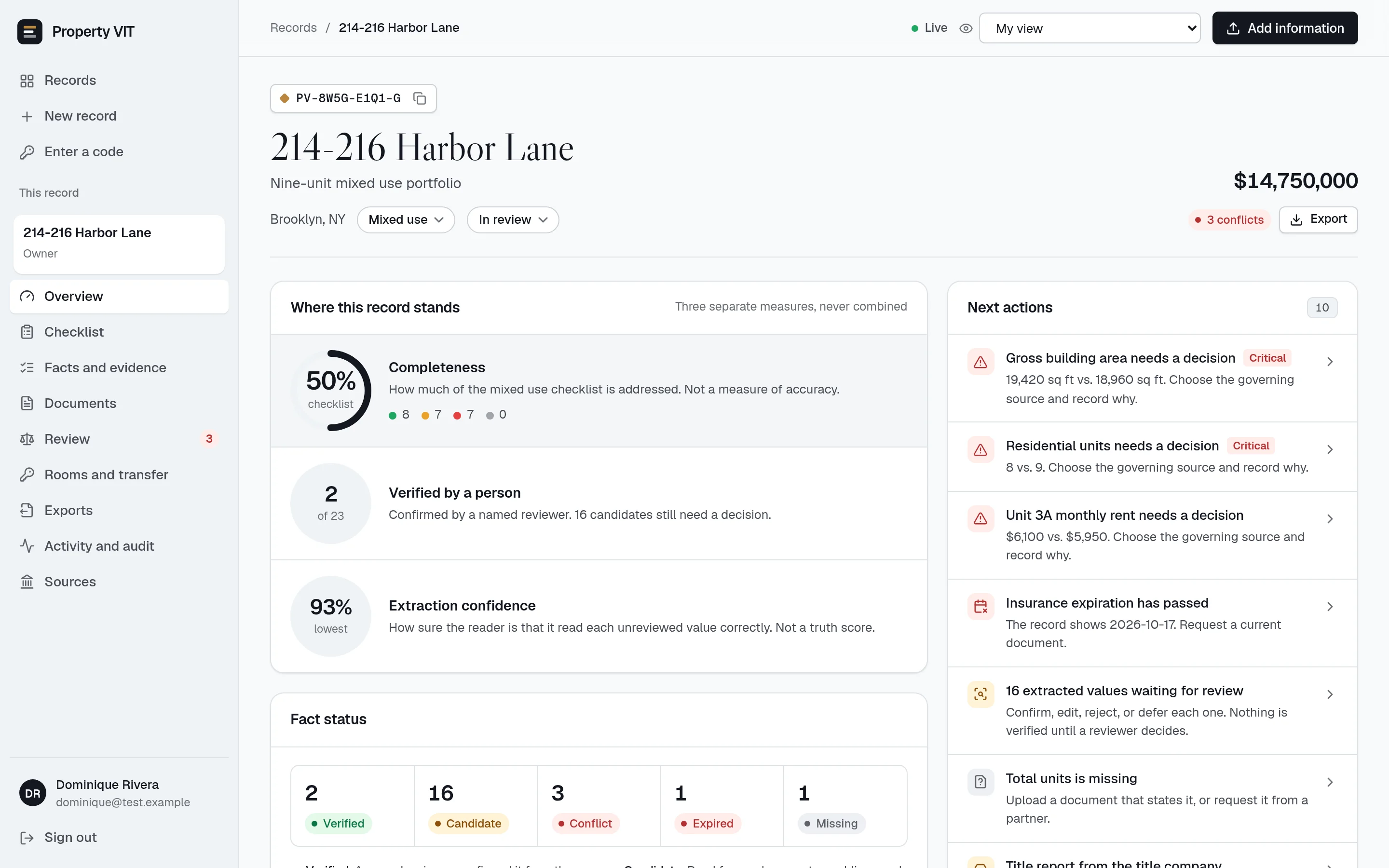
Forty documents.
One building.
They rarely agree.
The offering memorandum says one size. The city says another. The rent roll and the signed lease disagree on Unit 3A. Usually nobody notices until the appraisal, the lender, or the closing table.
Property VLT reads every document as it arrives and checks it against everything else in the record. The disagreement is on screen the same minute, and it stays there until a named person decides.
Every fact keeps its source.
Upload a rent roll, a lease, a tax bill, or a phone photo of a page. Each fact is recorded with the document, the page, and the exact words, so anyone can check it in one click.
- Only what the document states. Nothing estimated, nothing inferred.
- Values from different years are compared only with the same year.
- Nothing is overwritten. Old values stay in the history.
Monthly rent: Five Thousand Nine Hundred Fifty Dollars ($5,950.00), payable on the first day of each month.
Public records arrive first.
Where public records are connected, Property VLT pulls the official data before you upload a single file. Every document is then measured against it. New York City is connected today, and properties anywhere else build their record from the documents you add.
New York City sources: MapPLUTO (Department of City Planning), open violations (Housing Preservation and Development), NYC GeoSearch address index.
- Gross building area1,491,817 sq ft
- Lot area49,614 sq ft
- Year built1915
- Floors41
- Zoning districtC5-5
- Building classRB
- Total units6
Three codes.
One record for life.
Instead of attachments sent back and forth, the record stays in one place and people are let in by code.
Property ID
Issued once and kept for the life of the property, through every owner and every sale.
Access code
Opens one room. A buyer sees facts, financials, and leases; an attorney sees title and legal. Nothing else.
Transfer code
When the property sells, the owner issues it, the buyer enters it, the owner confirms. The record moves with its history.
Access and transfer codes are shown once and stored only as a fingerprint. Every join, view, and file opened is written to the record's history, and each entry is sealed to the one before it.
It stays with the property, not the deal.
Today, diligence is rebuilt from scratch at every sale. Here, the next owner inherits the verified record, every source, and every decision made about it.
- Record createdProperty ID issued. City record connected.
- Conflicts resolvedRent roll, leases, tax bill, insurance.
- Rooms openedBuyer, attorney, and lender, each to their date.
- Sold. Record transferred.New owner, same record, history intact.
Owners
One record of your building that you control. It gets more complete with every document and goes with the sale.
Listing brokers
Catch the discrepancies before a buyer's attorney does. Launch with confirmed facts and clearly labelled open items.
Buyers, attorneys, lenders
See exactly what you were given access to, with the source for every number.

Start the record your property keeps.
Enter any property address. Where public records are connected, they arrive first.
Start a record